Hebrews 11:1-3, 8-16 describes the nature of faith and illustrates faith through the example of Abraham. God promised Abraham both land and descendants, but Abraham never saw the fulfillment of either of those promises. And yet he looked forward to a heavenly city built by God. What does this have to do with hope in today’s world? How should we view heaven – and how should we view earth? Click here for Pastor David’s message on this passage.
Obscurity
A few weeks ago, our sermon text was Genesis 18:1-11, the story in which Abraham is visited by three mysterious guests. The text of Genesis is very clear: these were not simply ordinary guests, but in this encounter, God appeared to Abraham. This is very unusual, because throughout our scriptures, God does not make a habit of appearing to individuals. When God does show up, it is usually in the Old Testament, and even then the form used in Genesis 18 is unique. Only here does God reveal himself to someone in the form of three people.
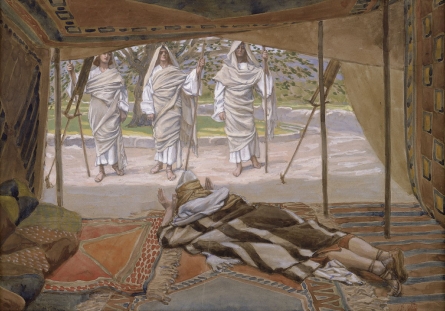
Early Christian theologians jumped on the number “three” and concluded that this was an appearance of the Trinity in the Old Testament. They suggested that the three men could easily be the Father, Son, and Holy Spirit. The History Channel’s recent miniseries The Bible even portrayed this story with three actors, one of whom – though his face was always hidden from the camera – played role of Jesus later on in the program. (Remember, our church has a DVD copy of this series which you may borrow any time!) However, finding the Trinity in Genesis 18 is an example of “reading into the text” – that is, making scripture say something that it doesn’t intend to communicate.
Genesis 18 is ambiguous and vague about the identity of Abraham’s three visitors. This certainly is God visiting Abraham, but the story is intentionally obscure. What is important to the story is not who the three men are, but rather what the three men are there to do. (In this case, they are there to make clear God’s promise that Abraham and Sarah would have a son, Isaac, within a year.)
One of my Bible commentaries contains this quote in reference to the Genesis 18 story:
“Obscurity is story’s way of telling us the truth about this God with whom we daily have to do, by reminding us of God’s hiddenness, of the concreteness of God’s revelation, and of the impossible possibilities that are open to all who believe.” (quoted in Victor P. Hamilton, The Book of Genesis: Chapters 18-50, New International Commentary on the Old Testament (Eerdmans Publishing Co.: Grand Rapids, 1995), p. 8)
God is far beyond our comprehension, and yet he has revealed himself to us in scripture and in Jesus of Nazareth. God is constantly among us through the Holy Spirit, and yet we sometimes have difficulty in discerning God’s presence in times of difficulty. God has power to do all things, and yet we can ignore what we consider “impossible possibilities.”
I am not theologically thrilled that The Bible miniseries used the actor who played Jesus to be one of the three guests who visited Abraham in its portrayal of this story. However, I am thankful that, at the very least, he was obscured from our view during that scene.
Let us always remember that we do not have God figured out. God is a profound mystery, one who chooses to reveal himself to us in specific ways for specific reasons. Let us lean into the obscurity of the Bible’s stories, because through obscurity we are reminded of how great and mysterious God is.
–Pastor David
Christ is Our Life
Today, Pastor David preached from Colossians 3:1-11 – and from inside the baptistry in our sanctuary. How does baptism relate to the presupposition of this passage, namely, that we have been raised with Christ? And how does this passage answer the biggest questions we face: those of identity and meaning and purpose? Listen in to today’s sermon recording here.
Old-Fashioned Hymn Sing
Last night, I had the privilege of leading a unique kind of experience to open this year’s 120th annual St. Louis Campmeeting: an “old-fashioned hymn sing.” Pastor Jim Sirks (from Battle Creek) and I played our guitars to accompany a crowd of over 100 that gathered in the old tabernacle on the St. Louis campgrounds. This event kicked off the campmeeting in stellar fashion, and I’d like to share a few reflections with you about the evening.
 In the Church of God, we have a diverse collection of songs. For this event, I selected sixteen of our “heritage hymns,” songs written by some of the earliest people in our movement. I grouped these sixteen into four groups of four, each group revolving around a different theme: Songs of Praise, Songs of Gratitude, Songs of Testimony, and Songs of Commitment. There may be other types of songs in our heritage, but even these four groups reveal a wide variety of songs in our tradition that can be used for any occasion. (By the way, we sang all the verses of all sixteen songs, and the whole event lasted only an hour.)
In the Church of God, we have people who can sing four part harmony. The acoustics of the old tabernacle – a small, open-air, wooden building with lots of hard surfaces – added to the musical experience produced by two acoustic guitars and a hundred voices. These were songs that people knew and wanted to sing. And many sang the parts (alto, tenor, bass) they have learned and have known for many years. Singing in harmony is a gift from God, and it does something spiritually to connect people together in worship. Worship (including but not limited to singing) is a communal activity, something we do together and not alone. (Remember that electronic amplification is less than a century old – newer than many of the songs we sang last night!)
In the Church of God, we sing what we believe. In late 19th Century America, church music was an instructional tool that helped people learn the contours of our faith. So much of our early heritage music contains a tremendous amount of theology. While we did not reflect on the theology of all sixteen songs last night, I did highlight one hymn in particular: “The Bond of Perfectness” by D.S. Warner. One of my seminary professors, Dr. Gil Stafford (previously pastor of East Ashman Church of God in Midland), once said that this was the epitome of Church of God theology in lyrical form, because it blends together our understandings of holiness and unity so beautifully:
How sweet this bond of perfectness, the wondrous love of Jesus;
A pure foretaste of heaven’s bliss, oh, fellowship so precious!Refrain:
Oh, brethren, how this perfect love unites us all in Jesus!
One heart, and soul, and mind we prove the union heaven gave us.Oh, praise the Lord for love divine that binds us all together;
A thousand chords our hearts entwine, forever and forever.“God over all and in us all,” and through each holy brother;
No pow’r of earth or hell, withal, can rend us from each other.Oh, mystery of heaven’s peace! Oh, bond of heaven’s union!
Our souls in fellowship embrace, and live in sweet communion.
These reasons, and several more, are why I am committed to having us sing at least one of our heritage hymns in each of our Sunday morning worship services. Which are your favorites?
–Pastor David
Doing vs. Becoming
During today’s Wednesday evening small group meeting, I was reminded of a profound truth about the path of Christian discipleship. We are studying the devotional book “Extreme Love” which was the centerpiece of the Focus 40 (Lent) season earlier this year. In one of the daily devotional readings, we discussed the difference between “doing” and “becoming”: how we as disciples should be concerned more about who we are becoming rather than what we are doing.

Does that apply to your life at all? We all live incredibly busy lives; I have even heard many retirees wonder aloud how they ever managed to go to work in years gone by. Our society places a high premium on what you can do, accomplish, or achieve. But I think there is something meaningful in thinking carefully about who we are becoming instead. How is your character being shaped? What changes to your values do you notice? How does faith in Jesus Christ form you into a new kind of person – even if you have been a believer for years or decades?
And now: how does this apply to us as a congregation? It is easy for churches to be wrapped up in programs, ministries, and events – things that we do. Rather than expend all our energy (and use all our God-given talents) on “doing,” what if we focused on “becoming”? How is God shaping us as a church? How is the Holy Spirit moving among us, to create something new among us? What does our future look like as a congregation? What are we going to become?
Two reminders. First, we will have “Mission Conversations” throughout the fall season to address these very questions. And second, you may join in this small group discussion by meeting with us Wednesdays at 7pm. Take advantage of these opportunities for spiritual growth!
–Pastor David
When God Comes to Visit
Once upon a time, Abraham had a surprise guest at his tent: three visitors who, as Abraham soon discovered, represented God. We can learn much from Abraham’s extravagant hospitality toward his guests – and Abraham’s belief in the strange promise they made to him and his wife Sarah. Listen to Pastor David’s message on Genesis 18:1-10!
The Gutsy Samaritan
In Luke 10:25-37, Jesus tells the well-known story of the Good Samaritan. What if we renamed that story to “The Gutsy Samaritan”? How does this story relate to the conversation about inheriting eternal life at the beginning of the passage? And what does this have to do with our lives today? Listen to Pastor David’s sermon on this famous parable.
The Institution of the Church
What does the title of this article mean to you? Does it bring to mind any images, people, or customs? Does it evoke feelings in your heart, either positive or negative? Or is it a foreign term to you because of the vagueness of the term “institution”?
When I use the phrase “the institution of the church,” I am referring to the necessary structure that develops among Christians of similar theology, history, and practice. Let me unpack that a little bit:
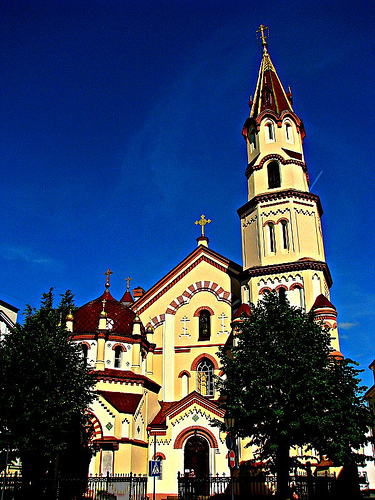
- “Necessary structure”: Just as people gather to live in neighborhoods, villages, towns, cities, regions, and nations, so do all human organizations. Any organization, if it is going to maintain its identity and purpose, must develop some kind of structure to keep itself going into the future. Over the course of time, the earliest Christians developed a structure to keep themselves afloat in the world; today, we call this structure the Roman Catholic Church. Even our brand of Christian faith, the Church of God Reformation Movement, has developed structures and systems that support the identity and purpose of this movement. That development began back in the 1910s and really flourished during the mid-1900s.
- “Similar theology, history, and practice”: Christian groups vary widely in these three categories, and perhaps others. But when believers have these in common, they tend to stick together. They have campmeetings and conventions; they have unity services and missionaries; they trade pastors and, all too often, church people. They might even work together on joint projects, like we did in Guatemala with Meridian Church of God earlier this year, and like we did with two other Church of God congregations for the Global Gathering last month. The structures we develop support and protect our investments (material and spiritual) in our beliefs, our shared history, and our shared experiences.
This is all well and good. But many people today have been driven away from God because of the problems in the institution of the church – whatever its label. And this isn’t good. In our humanness, we create issues that cause people to turn away from God. We argue among each other; we criticize those who disagree with us on political issues. We discriminate against those who aren’t like us; we harbor jealousy of those who are successful. We distrust those in power; we fail to consider the needs of “the least of these.” And all these things can occur within one particular church group – I know, because I have seen them in the Church of God itself!
Yet I do not run away. I remain committed to the Church of God (and to the Mt. Haley congregation in particular) because I believe in the Church of God’s theology, history, and practices. I find the institution frustrating at times, but I also find it incredibly valuable because it connects me to something bigger than myself. And at the same time, I constantly work to remember that the Church of God is connected to something bigger than itself as well. We speak openly about salvation, unity, and holiness with Christians in our own fellowship and those in other backgrounds. We do so because we share “one Lord, one faith, one baptism, one God and Father of all” (Ephesians 4:5-6 NIV) and we take seriously Jesus’s prayer that we might all be one (John 17:22-23).
With all this in mind, I invite you to read two more articles, these written by good friends of mine, Joe Watkins and Jael Tang. They are two of my “people” – the group I’ve mentioned to you before, my seminary friends who form for me a special community of support, inspiration, and challenge. Please take a few minutes to read what they have to say; I promise it’s worth your time.
Read Joe’s blog here: http://www.noggingrande.com/2013/07/10/three-reasons-its-cool-to-love-the-institution-of-the-church/
Read Jael’s blog here: http://akandatang-luke5.blogspot.com/2013/07/where-we-come-from-institution-and.html
–Pastor David
Small But Mighty
The story of how God healed Naaman, the Aramean army commander, of his leprosy is found in 2 Kings 5:1-14. Tucked into this story are a handful of minor characters who play crucial roles in helping this miraculous cleansing take place. What does this story have to say to our situation today? Listen in as Pastor David preaches on this Old Testament passage.
The Necessity of Gathering
At last week’s Global Gathering, a powerful thought captured my attention: as people of faith, we need each other to survive.

Pastor Jerry, Connie, and I had the privilege of meeting Sudipta Nanda, the church leader from northern India whose attendance at the Global Gathering our congregation helped to support. We met Brother Sudipta along with the pastors of our sister churches, Rev. Shannon New Spangler (Harvest Point Church of God, Lordstown, Ohio) and Rev. Jonathan Frymire (Orchard View Church of God, Grand Rapids, Michigan). Sudipta is a warm and compassionate man with a strong heart for Jesus Christ. He and his young family are committed to sharing the gospel among the millions of people in northern India. His presentation showed us many of the challenges he faces: other religions that are firmly entrenched in his region, social and community problems that oppress individuals and families, and physical needs that face everyone on a daily basis. As pastor of a congregation and overseer of over 700 others, Sudipta has a tremendous amount of work.
And yet, on many occasions, he expressed his gratitude to us for helping him to come to Anderson. This experience of gathering with other believers from around the world was a powerful, meaningful experience for Sudipta.
Personally speaking, this Global Gathering served an important purpose for me, as well. I was refreshed and renewed through rekindling relationships with some very dear friends of mine, including the two pastors mentioned above. We have always taken the opportunity to spend time together at this annual convention. Often, we have stayed up late into the night talking about important issues of life and ministry – and, to be very honest, simply having a lot of fun together, too.
But this year, I came away with another impression. I can imagine how vital it was for Sudipta to come to this Global Gathering; his ministry will surely benefit from his experiences. For me, I am learning that this kind of connection is indispensible; I would not be who I am today if I did not meet regularly with these important individuals who can speak truth and joy into my life. Going to Anderson is an annual spiritual pilgrimage, not for the location but for those whom I meet there.
Do you have meaningful relationships like these in your life? Are there people who help you make sense of life and without whom you would feel lost? How often do you get to see them, to be refreshed by them, and to be spiritual refreshment in their lives?
Are you fortunate enough to worship in the same congregation with any of those individuals? How important it is for the saints of God to come together each week for refreshment, nurture, and companionship!
Let us not give up meeting together, as some are in the habit of doing, but let us encourage one another–and all the more as you see the Day approaching. (Hebrews 10:25 NIV)