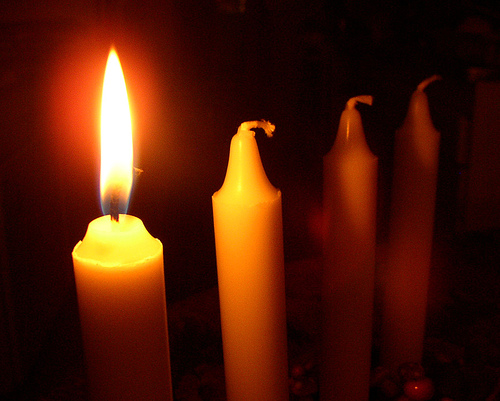
The Importance of (Total) Bible Reading

Have you ever read the Bible all the way through?  Have you done that more than once in your life?  Do you make a habit of reading scripture every day?  Or perhaps some days?  Or maybe once in a while?  Maybe you have a Bible that’s good at collecting dust on the shelf at home.  Or maybe you don’t even have a Bible at home at all.

I don’t offer any of those possibilities as an attempt to make you feel guilty or unrighteous – or holy or super-righteous, either.  It’s simply true that everyone has a different level of engagement with God’s written word.  Some people are more inclined to make it part of their everyday reading experience.  Others really have no desire to do anything with the Bible at all.  And there are many options in between.

photo by abcdz2000
photo by abcdz2000

So why read the Bible in the first place?  We believe that this book is God’s complete, inspired revelation of himself in written form:  everything we need to know about the Lord is included in its pages.  The full plan of salvation in Jesus Christ is there; a complete set of expectations for how we live, behave, and make choices is there.  Answers to life’s deepest questions are there; even those questions which have no answers are there.  The history of God’s relationship with his people is there.  It is trustworthy, reliable, verifiable, meaningful, hopeful, encouraging, challenging, comforting, disturbing, intriguing, revealing, and enlightening.  For anyone in a relationship with God, or for anyone wondering who God is, the Bible is indispensable reading material.

So why read the whole Bible, then?  Surely there are parts of it that are less interesting or useful than others.  (All those genealogies in the Old Testament, come on!)  I agree, some parts of the Bible are more appealing than others.  That’s because the Bible is comprised of many different genres of literature:  history, songs, philosophy, poetry, gospel stories, letters, prophecies, and so forth.  And each book of the Bible was written by a unique author (or authors) from a unique perspectives.  There’s a wealth of material to learn simply by reading and studying this book.

Jesus is the most important character in the Bible, of course, but his story becomes richer, fuller, more powerful, more complete when we read all of scripture with him in mind.  The entirety of the Bible – from Genesis through Revelation – is necessary reading material for the disciple of Jesus.

So have you read the Bible all the way through before?  If not, why not begin now?  But I’ll caution you:  if you haven’t read the Bible from start to finish before, don’t read it like a regular novel, starting on page 1 and going to the end.  I guarantee it, by the time you get to Leviticus or Numbers, you’ll run out of steam.  If you want to read the Bible all the way through, there are a bunch of plans and translations available to help keep it interesting.  Come talk with me any time – we’ll work on it together!

–Pastor David
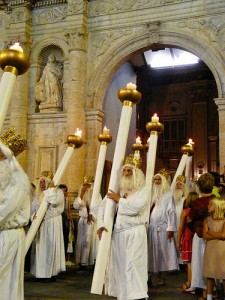
How to be a Levite

It’s 2013, and that means new things are on the horizon!  At Mt. Haley, that is very true in an interesting way.  This year, one of our focuses will be on learning more about the nuts and bolts of how and why we worship God.  Once a month, after our Sunday morning service, we will have an event entitled “How to be a Levite.”  Each of these events will give you the opportunity to learn about the various roles and responsibilities of different people in our worship services.

In Old Testament days, Levites were people of the tribe of Levi – the tribe of Israelites who were in charge of the tabernacle of God.  Moses and his brother Aaron were from the tribe of Levi, and Aaron’s descendants became priests and Levites, people who were designated for leadership in the worship of God at the tabernacle and, later, the temple in Jerusalem.  Levites play a major role in the Old Testament, beginning in the book of Numbers.  Take a look at 1 Chronicles 15 and see how important the Levites were when King David brought the Ark of the Covenant to Jerusalem for the first time.

photo by Xavier68
photo by Xavier68

Have you ever wondered what it’s like to be an usher or a chairperson in our worship services?  Have you thought about reading scripture during the service, or perhaps have you wanted to improve your skills?  How about participating on a newly-forming drama team or singing with the praise team?  Why do we do all these things (and many more)?  And how do we do them well, so that God is praised by all who gather for worship?

Those are the kinds of questions that this series will address.  You are welcome to attend any or all of these sessions, regardless of whether you are interested simply in learning or in future participation.  Just stay after church on the announced Sunday, share in lunch with those who stay, and then enjoy learning about our worship services!

This month, on January 20, we will focus on our audio/visual systems.  How does our sound system work?  How does the projection system work?  Why are these systems vital to our worship experience?  How can we use these systems to help people worship well?  Stay after church on the 20th and we’ll discuss all these questions and more!

–Pastor David

A Party for Jesus: It’s Life Changing

Elizabeth and Mary, two pregnant women in very different yet similarly miraculous circumstances, meet each other in Luke 1:39-45.  Their yet unborn children, John the Baptist and Jesus, meet each other in this story as well.  What can this story tell us today about the transformative, life-changing power of an encounter with Jesus Christ?  Click below to hear Pastor David’s sermon on this fourth Sunday of Advent:

 Listen now!

A Pure Glass of Water

I was visited by two Jehovah’s Witnesses at the church this afternoon.  One of these two ladies has visited me several times this year, each time with a different companion.  I generally enjoy spending time with them, although I wonder why they visit me (will I convert? probably not!) and why I often feel on the defensive when they visit (do I have anything to fear? no!).

Jehovah’s Witnesses express faith in Jesus Christ, believe in his death for the atonement of sins, and generally try to please God with how they live.  (As a side note, they do not talk much about Jesus’s resurrection.  They say, quietly, that “God resurrected Jesus, but not as a human.”  This is an unorthodox and non-biblical belief.  If Jesus was not raised to life again as a real human being, then his power over sin and death is greatly diminished.  In my understanding, the Jehovah’s Witnesses’ mistaken beliefs about Jesus are, in part, what make them non-Christians.)

Yet the reason for today’s visit was to discuss the meaning of Christmas and how “pagan” (to use my friend’s word) many of our Christmas celebrations are.  She said that it is more important for God’s followers to live in ways that please him all year long rather than simply to remember Jesus for one day (or one season) of the year.  She said that true Christians should not celebrate Christmas at all because of its pagan origins – which is a standard Jehovah’s Witness belief.

photo by blmurch

To illustrate her beliefs about Christmas, she had me imagine a glass of pure water.  If you just add a little bit of cyanide or other poison to the water, it may still look like water – and it may not kill you.  Eventually, though, if you keep adding poison to the water, it will be deadly to someone who drinks it.  It’s best to stick with the pure water.  My friend said this is what “so-called Christians” have done with the Christmas season, especially by adding so many commercial and marketing and gift-giving events to the month of December.

Friends, this is exactly what these visitors from the Jehovah’s Witnesses have done:  they have gotten used to a certain amount of “poison” in their water.  Each time my friend visits, I am given another piece of literature from the Watchtower organization.  (I enjoy building up a library of works from all sorts of religions, such as Islam, Mormonism, the Witnesses, etc.)  Jehovah’s Witnesses must adhere to everything the Bible says – this they claim readily – as well as everything the Watchtower organization says, which often dictates how people should interpret the Bible.  You cannot disagree with anything found in these publications of the Jehovah’s Witnesses if you want to remain in good fellowship with that group.  And you must “work out your salvation” by going from door to door in order to spread the message of the kingdom of God – and, incidentally, to spread the Watchtower’s literature.

How much poison can a person get used to?  How many good works must a person do to please God?

As for us, “the Bible is our rule of faith, and Christ alone is Lord.”  All other resources outside the Bible can be helpful or harmful.  We are free to study the Bible, to question it, to test it, to doubt it, to live according to it.  But we must constantly be on the lookout for modifications to true biblical faith that put, in this case, too much emphasis on our own works for righteousness and too much emphasis on believing everything a human leader or organization says.

I don’t think my Jehovah’s Witness friend realized that her illustration applies perfectly to her very own life.  And that makes me sad.

–Pastor David

A Party for Jesus: What Will I Give?

Christmas is the season for giving gifts, but as people of faith we often ask, “what gift could I bring to Jesus?”  What are acceptable gifts in God’s eyes, anyway?  And how should we understand our role as gift-givers to God between the first and second comings of Jesus?  Click below to hear Pastor David’s message on Malachi 2:17-3:5, and take note of the kinds of offerings that the Lord accepts!

Listen now!

A Party for Jesus: Who is Invited?

Advent is a birthday party for Jesus – and an anticipation of a greater party at the end of the age!  The prophet Jeremiah spoke about eternal hope for the people of God in Jeremiah 33:14-16; then Jesus himself spoke about hope for a future return of the Son of Man in Luke 21:25-28,34-36.  How do these passages answer the question about who is invited to the party?  Click below to hear Pastor David’s message on this subject.

Listen now!

Go to Where the Water Is

Today, I took the afternoon (as I often do on Thursdays) to finish up the sermon for Sunday morning.  A good bit of my time in sermon writing is spent in thought, prayer, and meditation, and so I often find myself looking out the windows of my church office while I organize my thoughts.  Today, I saw something I haven’t noticed before, something that interrupted my train of thought, something I’d like to share with you:

The snow on the roof is melting in the sunlight, and water drops are falling off the edge of the roof onto the ground below.  Suddenly, a few birds – cardinals, from the looks of one of them – land on the edge of the roof, bend over, and drink from the water droplets as they trickle off the edge of the building.

photo by ccho

I think what struck me about this scene is just how odd of a drinking position that must be for the birds.  Can you imagine jumping into a stream of running water, facing downstream, bending over, and drinking until your thirst is quenched?  I suppose the birds found this water much more palatable than the running water in nearby Bullock Creek – a stream from which neither birds nor humans would drink willingly!

These birds went to where the water is, and they found satisfaction for their thirst.  Water is fuel for life:  nearly all species of plants and animals depend on water for survival.  So we too, in our daily lives, need spiritual refreshment and nourishment.  Where do we find water for the soul?

“On the last and greatest day of the Feast, Jesus stood and said in a loud voice, ‘If anyone is thirsty, let him come to me and drink. Whoever believes in me, as the Scripture has said, streams of living water will flow from within him.’ By this he meant the Spirit, whom those who believed in him were later to receive. Up to that time the Spirit had not been given, since Jesus had not yet been glorified.” (John 7:37-39 NIV)

Friends, in your everyday walk of faith, go to where the water is:  even Jesus Christ, the one whose birth we celebrate this season, whose glory was revealed on the cross and in the empty tomb, whose Spirit dwells in those who believe, whose return we await with great hope and anticipation.  Drink deeply from this source of life, no matter if it seems like a strange thing to do from the world’s perspective.  There is no better way to live!

–Pastor David

Already and Not Yet

As people of faith in Christ Jesus, we celebrate this current season with special fervor and religious anticipation.  The Christmas season, while maddeningly materialistic and terribly self-centered in our American culture, still holds special meaning for Christians.  We want to encourage people in our community to “keep Christ in Christmas” – yet at the same time, we should remember why we celebrate this season and what it means for the faith.

photo by Per Ola Wiberg

We are people who believe in an “already and not yet” kingdom of God.  God’s reign over the universe broke into this world in personal, tangible form through the person of Jesus Christ.  This was the content of Jesus’s preaching (see Mark 1:14-15), and this was the reason that Jesus was born into the world (see John 18:33-38).  He reigns in our hearts in the present tense.  He conquers sin in our lives in the present tense.  His rule is already secure because of his nature, his work on the cross, and his empty tomb.

And yet the kingdom of God is not yet completely fulfilled.  We await Jesus’s return at the end of the age, at which point his kingdom will come in its completeness and perfection (see Revelation 22:6-21).  There will be no more suffering in the future tense.  The presence of God will fill us with heavenly light in the future tense.  We yearn for Christ to return even within our lifetimes so that we might witness his reign being made complete.

We are “already and not yet” Christians.  We believe in an “already and not yet” Lord, one who has already atoned for our sins but has not yet brought about the ultimate fullness of his kingdom.

This ties into our observance of the season of Advent, the season in which we celebrate the “coming” (“advent”) of Jesus Christ:  both his birth into the world and his second coming at the end of the age.  We are “already and not yet” Christians who celebrate an “already and not yet” Lord!

We tend to focus on the past tense story of Christmas, the birth of Jesus as a baby in Bethlehem, during this season.  Let us always remember, though, that our faith points us toward a future tense story of Advent, which is the return of Christ in final victory and triumph.  Even as Jesus came to earth in the form of a tiny, humble baby, so he will return again as ultimate, undisputed, unmistakable King.

Who needs Black Friday sales, Cyber Monday advertisements, nonstop secular Christmas songs, and stereotypical American indebtedness to celebrate this season?  Let’s celebrate Advent, in word and in deed, as people of true faith.

–Pastor David