In John 17:20-26, Jesus prayed for those who would believe in his message. That includes believers today, of course! What lessons can we learn from this prayer? How does Jesus’s prayer affect our everyday lives today? And what crazy acronym did Pastor David come up with this week? Take a listen to this week’s sermon and find out:
Peace for the Confused
Have you ever been confused about life? Have you wondered where God is in the midst of your daily struggles? You’re not alone: Jesus’s disciples felt the same way after his crucifixion, something Jesus prepared them for in John 14:23-29. Here is a link to Pastor David’s sermon on this passage, presenting this week’s gift from Jesus to his disciples: peace for the confused.
Purpose for Those Who Follow
A disciple is one who follows someone else. What happens when the one being followed disappears from the scene? This is the situation foreseen by Jesus in John 13:31-35, a passage dripping with emotion in which Jesus prepares his disciples for his departure through crucifixion. How does Jesus’s gift of purpose for his disciples affect us in the church today? Here is Pastor David’s message on this passage.
What is Ordination?
Last October, I reported to you that the Credentials Committee of the Church of God in Michigan had approved me for ordination. I was indeed ordained at the state’s General Assembly meeting in November, and now we are in the midst of planning for my formal ordination service at Mt. Haley on May 25, one month from today. Through a couple of conversations, it became apparent to me that it might be helpful for you to know exactly what this process has entailed and what it means for my ministry.
The Church of God ordains pastors on a state-by-state basis. I began the ordination process in 2007 while I was in seminary in Indiana. I met with Indiana’s Credentials Committee twice, took a Bible content exam, and began reading a selection of required books. This was in addition to my seminary reading list: over five years, I took ninety hours of graduate courses to earn a Master of Divinity degree. Also, as part of the ordination process, I wrote and defended fourteen theological statements (which are available on our website, if you’re interested to read them). All of this preparation was to ensure that I am theologically sound and at least somewhat prepared to enter a ministry position.
During this time, I moved through the first two phases of the ordination process. In Indiana and Michigan (and most states), the Church of God classifies ministers as “commissioned,” “licensed,” and finally “ordained,” in increasing order of call, trust, and responsibility. At the beginning of my process, I was “commissioned” in Indiana; that was a recognition of the fact that I sensed a call to enter ministry – and that it seemed right to the committee as well. After I completed the work listed in the previous paragraph, I became “licensed.” This allowed the world to consider me a minister from a legal perspective: I could perform wedding ceremonies and file taxes as a minister. For all intents and purposes, a licensed minister can do anything you’d expect a fully ordained minister to do.
All of this happened in Indiana. Then, when Mt. Haley called me to become its senior pastor and Tara and I moved to Michigan, my ministerial credentials were transferred to the Church of God in Michigan. Since that time, I have met with Michigan’s Credentials Committee twice so they could review my theological statements, get to know my call to ministry, and prepare me for full ordination.
Another part of that preparation is a relationship with a “supervising mentor.” Rev. Dr. Kevin Earley, pastor of the Metropolitan Church of God in Detroit, was assigned to serve in this role for me. We were acquaintances from seminary – he earned his doctorate while I worked on my master’s – and in the past year we have had a handful of phone conversations about pastoral ministry, its challenges, and its opportunities.

Another component is a document called a “Life and Ministry Plan,” which is like a personal mission statement for pastors. This “LAMP” is a living, growing document that is to inform and adapt to my life and ministry over the course of my life. This requirement was waived in my case because I am currently working on my “LAMP” with my “SHAPE” group (“Sustaining Health And Pastoral Excellence”), a group of five pastors who meet each month for connection, support, and mutual growth. (My “LAMP” should be completed sometime this year.)
All of this culminated in the Credentials Committee’s recommendation that I be presented for ordination at the state General Assembly meeting last November. At that meeting, four other candidates and I were presented to the assembly. We each gave a three-minute testimony/summary of our call to ministry, and then the gathered ministers and church representatives voted whether or not to ordain each of us. The rules state that if six “no” votes are received for any candidate, then his or her ordination is withheld for further consideration. That did not happen in my case, so my ordination was technically approved in November.
What remains is a formal ordination service, which we have scheduled for May 25. At this service I will be given my official certificate of ordination, and the whole process will finally be complete.
Ordination is a call to ministry in the church. If I were not serving in an official ministry position, I could not be ordained. And in the future if I should not have a ministry position for a significant length of time, my ordination credentials could be revoked. Ordination means that I am fully recognized as a minister in the Church of God, but it also means that I am fully accountable as a minister in the Church of God. I am welcome to serve as pastor, but I am not free to do whatever I wish. I am trusted to serve the church well, but I must not abuse that trust. I have the support of the Church of God movement behind me, but that is not license for me to go astray from what God intends for my life and ministry.
The Bible is full of examples of priests and Levites who were called to serve God. Many of them served faithfully for their whole lives, while others went astray and were censured by God and by the faith community. I intend to be found in the “faithful” group when the final tally is counted.
If you have any questions about the ordination process or what it means for me or for Mt. Haley, please feel free to ask me!
–Pastor David
How to be a Levite: Reading Scripture
This past Sunday, a group of us worked together on the practice of reading scripture in worship. Reading scripture is something that should be taken seriously and done well, because the Bible is the primary way that God speaks directly to us!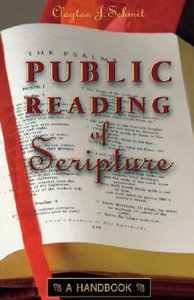
By popular demand, the notes from this workshop are available here in PDF format. These ideas may be helpful to you in your own devotional reading of the Bible, even if you are not a regular scripture reader in church.
For more information and for a terrific resource on the public reading of scripture, please check out Clayton J. Schmit’s book Public Reading of Scripture. Buy a copy yourself, or see me and I’ll be glad to lend you mine!
–Pastor David
Persistence
The other day, I saw a bug in my office. Normally, I exterminate such pests without a second thought, but this time was different. This time, I was already deep in thought working on this week’s sermon, and the bug was on the other side of my desk. Rather than getting up, walking around the desk, and doing the necessary deed, I decided to take the more passive approach: I just watched the bug for a few minutes.

This bug had it in its little brain that the most important thing in the world was climbing straight up the window. Hanging onto the window for dear life, it crawled higher and higher until it lost its balance. Then it fell harmlessly to the windowsill and began its trek upward again. Over and over again, this cycle repeated itself: the bug climbed up, fell down, and climbed up again.
One word came to my mind as I watched this bug: persistence. No matter how many times it fell down, it got back up and began the upward climb once more. And then I thought, “There’s a sermon in that.”
Of course, there is a humanistic lesson to be learned: no matter how many times we fail, we must pick ourselves up and move on, resume the course, carry forward one more time. The world is good at teaching us this message through all sorts of motivational speakers.
But there’s something deeper here. While my office bug was able to pick itself up and climb upward on its own power, we have no power to pick ourselves up spiritually. While the bug naturally showed persistence in achieving its goal, we struggle to move forward in our walks with Christ. It is natural for us to be sedentary, hopeless, passive.
The goal for us as disciples of Christ is in the same direction as the bug’s goal: to move upward, to climb higher: to grow and become more like Jesus, to bring about the kingdom of God on earth. And yet so often we find ourselves falling back into old habits and unredeemed ways of living. We look around, startled to find ourselves where we began, having the same spiritual ground yet to cover.
This is the point at which God’s grace steps into our lives. Grace is what God gives to us that we absolutely do not deserve. Knowing God, having faith, receiving forgiveness for our sins – these and many others are gifts from God brought by his grace in our lives. Another gift from God is how he picks us up when we fall and puts us back on the path of growth. We simply can’t do that by ourselves.
Yet such is our journey: ever upward, ever toward Christ, no matter what lows we experience. Carry on, fellow believers, and keep the goal always in mind!
Go to the ant, you sluggard; consider its ways and be wise! It has no commander, no overseer or ruler, yet it stores its provisions in summer and gathers its food at harvest.
How long will you lie there, you sluggard? When will you get up from your sleep? A little sleep, a little slumber, a little folding of the hands to rest— and poverty will come on you like a thief and scarcity like an armed man.
(Proverbs 6:6-11 NIV)
–Pastor David
Clarity for Those Who Listen
Jesus is the Good Shepherd, and his sheep know his voice. Do you consider yourself one of his sheep? Do you make a practice of listening for the Lord’s voice? Take a few moments to read John 10:22-30, and then listen to Pastor David’s message on this passage. God is still speaking to his people; let us be diligent in listening!
Restoration for Those Who Fail
Peter failed miserably by betraying Jesus three times. Yet after the resurrection, a miraculous catch of fish, and a lakeside breakfast, Jesus restored Peter three times – and gave him work to do. How does this story (John 21:1-19) relate to our struggle to deal with failure in our lives? Click below to hear Pastor David’s sermon on the gifts Jesus gave his disciples in this passage:
Grace to Those Who Doubt
This week we begin a series on “What Jesus Gave” – that is, what Jesus gave to his disciples, and what he gives to us. This Sunday, Pastor David helps us look inside the story of “Doubting Thomas” (John 20:19-31) to discover four life-transforming gifts that Jesus provides for his followers. Click the link below to listen to this message!
Is This Just Crazy Talk?
On Easter Sunday, we remember and celebrate the resurrection of Jesus from the dead. It’s a truth that forms us as people of faith, but have you ever stopped to wonder: is this just crazy talk? Are we expected to believe something that’s just simply ridiculous and unbelievable? Click the link below to hear Pastor David’s message on Isaiah 65:17-25, an Old Testament passage with similar “crazy talk” characteristics.